
Currently Empty: $0
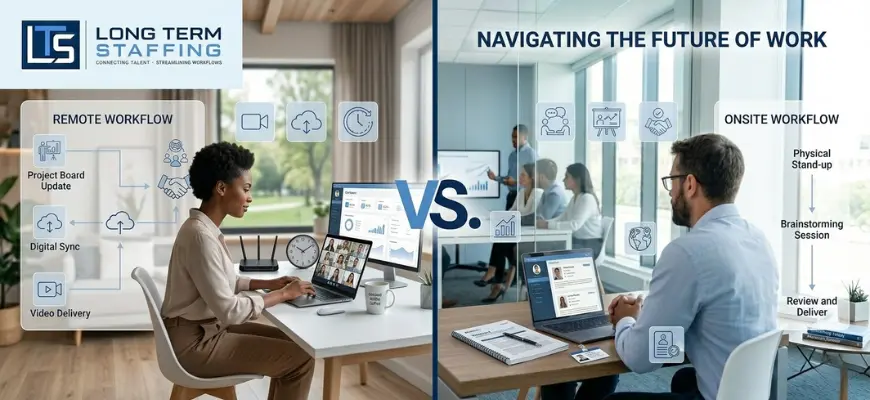
Remote vs Onsite Employees: Which Is Better for Your Business?
Choosing between remote vs onsite employees has become one of the most important decisions for modern businesses. With changing work environments, digital tools, and global talent access, companies are rethinking how teams should operate for maximum productivity and efficiency.
This decision is no longer just about location—it affects performance, communication, hiring costs, employee satisfaction, and long-term business growth.
In this guide, we will compare both work models in detail and help you understand which approach is better for your organization, including how a hybrid workforce model is shaping the future of work.
Understanding Modern Work Models
Work environments have evolved significantly in recent years. Traditional office-based roles were once the standard, but technology has made it possible for employees to work from anywhere.
Today, businesses commonly use three models:
- Onsite employees working from office locations
- Remote employees working from home or different locations
- Hybrid workforce combining both models
Each model has unique advantages depending on business type, industry, and goals.
What Are Remote Employees?
Remote employees work outside a traditional office environment. They use digital tools, cloud systems, and communication platforms to stay connected with their teams.
This model is commonly supported by remote staffing strategies, where companies hire talent from different cities or even countries.
Remote work allows employees to complete tasks from home, co-working spaces, or any location with internet access.
What Are Onsite Employees?
Onsite employees work from a physical office or company location. This traditional setup requires employees to be present during working hours and collaborate face-to-face with team members.
Many industries still depend on onsite work due to operational requirements, security needs, or hands-on tasks.
Productivity Comparison Between Remote and Onsite Work
Productivity is one of the most debated factors when comparing remote vs onsite employees.
Remote employees often benefit from:
- Fewer office distractions
- Flexible working hours
- Better work-life balance
- Personalized work environments
Onsite employees benefit from:
- Direct supervision
- Immediate communication
- Structured work environment
- Faster decision-making in teams
The reality is that productivity depends more on management style and tools than location alone.
Communication and Collaboration Differences
Communication plays a key role in business success.
Onsite employees communicate more naturally through face-to-face interactions, which helps in quick problem-solving and teamwork.
Remote employees rely on:
- Video conferencing
- Messaging apps
- Project management tools
- Cloud collaboration platforms
While remote communication is effective, it requires strong systems and discipline to avoid misunderstandings or delays.
Cost Impact on Businesses
One of the biggest advantages of remote staffing is cost savings.
Remote employees reduce expenses such as:
- Office rent
- Utilities
- Onsite infrastructure
- Daily operational costs
Onsite employees, however, may increase overhead costs but can improve control and supervision.
A well-planned remote staffing strategy can significantly reduce business expenses without affecting performance.
Employee Satisfaction and Work-Life Balance
Employee satisfaction is directly linked to productivity and retention.
Remote employees often report higher satisfaction due to:
- Flexible schedules
- No commuting time
- Better work-life balance
- Comfortable work environment
Onsite employees may benefit from:
- Social interaction
- Clear separation between work and home
- Team bonding activities
However, lack of flexibility in onsite roles can sometimes lead to burnout.
Security and Data Protection Concerns
Security is an important factor, especially for companies handling sensitive data.
Onsite employees work in controlled environments where IT systems and data access can be closely monitored.
Remote employees require:
- Secure VPN access
- Data encryption tools
- Strong cybersecurity policies
- Regular monitoring systems
With proper systems in place, remote staffing setups can also be highly secure.
Hiring Talent: Global vs Local Access
Remote staffing has completely changed hiring strategies.
With remote staffing, companies can hire talent globally instead of limiting themselves to local candidates.
This leads to:
- Access to specialized skills
- Faster hiring process
- Larger talent pool
- Competitive hiring advantage
Onsite hiring is usually limited to local availability, which can restrict options in competitive industries.
Flexibility and Business Scalability
A hybrid workforce offers the most flexibility for growing companies.
Businesses can:
- Keep core teams onsite
- Hire remote specialists for specific tasks
- Scale teams based on demand
- Adjust operations quickly
This flexibility helps companies respond to market changes more effectively.
Performance Monitoring and Accountability
Monitoring employee performance differs in both models.
Onsite employees are easier to supervise directly, which can help with accountability.
Remote employees require:
- Clear KPIs
- Task tracking tools
- Regular check-ins
- Performance dashboards
With the right systems, remote vs onsite employees can perform equally or even better than onsite teams.
Team Culture and Engagement
Company culture plays a big role in long-term success.
Onsite environments naturally encourage:
- Team bonding
- Casual interactions
- Strong workplace culture
Remote teams must rely on:
- Virtual meetings
- Online engagement activities
- Strong communication systems
A balanced hybrid workforce often creates the best cultural mix.
When Remote Work Is the Better Choice
Remote staffing is ideal when:
- Roles are digital or task-based
- Companies want global talent
- Cost reduction is a priority
- Flexibility is important
- Work does not require physical presence
Industries like IT, marketing, and customer support benefit greatly from remote models.
When Onsite Work Is the Better Choice
Onsite work is better when:
- Physical presence is required
- High-security environments are involved
- Teams need constant collaboration
- Hardware or machines are used
- Real-time supervision is important
Industries like manufacturing, healthcare, and logistics often prefer onsite setups.
The Rise of Hybrid Workforce Model
The hybrid workforce model is becoming the most popular choice for modern businesses.
It combines:
- Remote flexibility
- Onsite collaboration
- Balanced productivity
- Improved employee satisfaction
This model allows companies to enjoy the best of both worlds.
Business Impact of Choosing the Right Model
Choosing the right work model affects:
- Employee productivity
- Operational costs
- Hiring success
- Customer satisfaction
- Business growth
There is no one-size-fits-all solution. Each company must evaluate its goals, industry needs, and workforce structure.
Conclusion
The debate of remote vs onsite employees is not about which one is better universally, but which one fits your business needs.
Remote work offers flexibility, cost savings, and global hiring opportunities. Onsite work provides structure, direct communication, and stronger supervision.
In most modern organizations, a hybrid workforce combined with smart remote staffing strategies delivers the best results.
Businesses that adapt to flexible work models will stay more competitive, efficient, and attractive to top talent in the long run.
FAQs
1. Which is better for business: remote or onsite employees?
It depends on your industry and goals. Remote work is flexible and cost-effective, while onsite work offers better supervision and collaboration.
2. What is a hybrid workforce?
A hybrid workforce combines remote and onsite employees to create a balanced and flexible work environment.
3. Is remote staffing cost-effective for companies?
Yes, remote staffing reduces office expenses and expands access to global talent, making it highly cost-effective.
4. Do remote employees perform as well as onsite employees?
Yes, performance depends on management systems, communication tools, and clear goals rather than location.
5. What industries benefit most from remote work?
IT, marketing, customer support, and digital services benefit most from remote work models.
6. What are the biggest challenges of remote work?
Communication gaps, time management, and cybersecurity concerns are the main challenges if not properly managed.

 0
0